
Free playbook for RevOps, Sales Ops, and HubSpot admins
Native HubSpot quoting got better in 2026. Here's where it still leaks.
- The 6 patterns that stop revenue leakage in complex B2B sales — named problem, strategy, recipe
- A diagnosis scorecard: six warning signs you can self-score in 60 seconds
- The honest answer to "but native just added Quote Rules — isn't that enough?"
Get the playbook
★★★★★ 5.0 on the HubSpot Marketplace · 400+ installations · Leading Partner
What's inside the playbook
A field guide, not a brochure. Diagnosis first, then the fix — all of it inside HubSpot.

The diagnosis scorecard
Six warning signs, self-scored in 60 seconds. The more that apply, the more margin is at risk.

The honest native answer
What Spring 2026's Quote Rules, Contracts, and custom modules actually added — and where native still caps out.
Two before-and-after vignettes
One industrial, one SaaS — real quoting messes and what fixing them looked like, pattern by pattern.
But native got better in 2026. Isn't that enough?
Honestly: it got a lot better. Quote Rules (public beta, Enterprise), Contracts (public beta), and custom quote modules are real progress — and the playbook says so.
Here's where it still caps out. Approvals stop at 5 sequential steps. There's no true price-book or formula pricing at scale beyond the product library. And G2 reviewers — not us — say quote templates "lack flexibility for complex pricing scenarios."
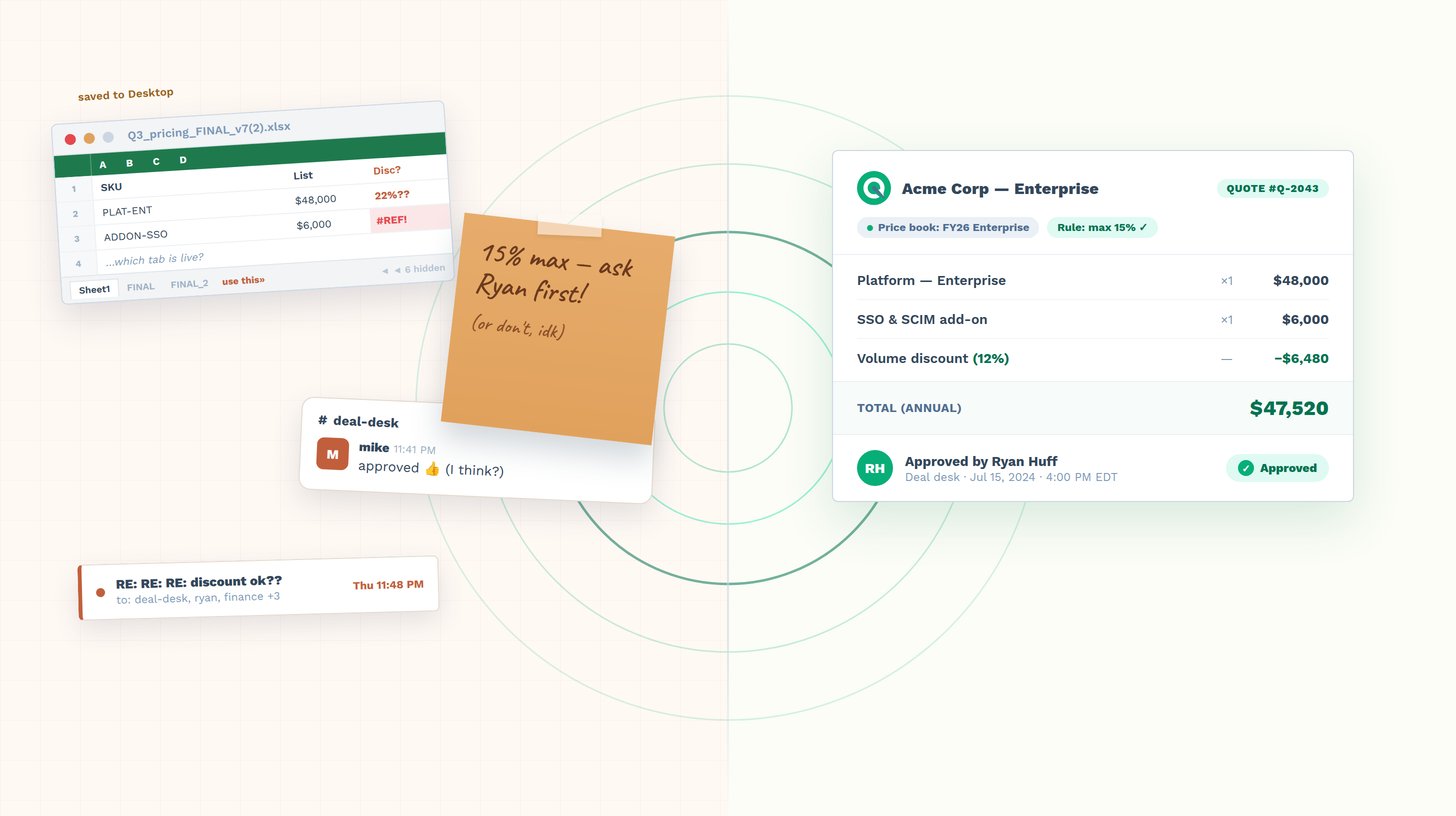
The test is simple: if your leakage lives in the configuration or the price, not the approval, you've outgrown native. Approvals catch a bad discount after a rep proposes it. They don't stop the wrong configuration or the stale price that came before it.
Six patterns. Each one closes a specific leak.
- <strong>The Price Floor</strong> — reps discount without guardrails, so the floor moves to the system level
- <strong>The Approval Fast Lane</strong> — informal loops kill velocity; routed approvals get an SLA inside HubSpot
- <strong>The Configured First Quote</strong> — make an incompatible configuration impossible to quote
- <strong>The Dynamic Price Book</strong> — tie pricing to live inputs instead of memory or a desktop spreadsheet
- <strong>The Guided Rep</strong> — encode your best seller's pricing knowledge into the quoting flow
- <strong>The Auto-Quote</strong> — take the rep out of the loop for standard repeat and renewal orders
Questions we'd ask too
Do I even need this, or is native HubSpot enough?
If your products don't need configuration and your pricing fits the product library, native is fine — keep using it. The playbook's scorecard tells you in 60 seconds whether you've hit the ceiling.
What does Quotivity cost?
Pricing is public on the HubSpot Marketplace: about $5,000/yr for Pro and Enterprise portals, including 5 users, then $600 per additional user per year. Margin recovered on one bad quoting quarter typically covers it.
How heavy is implementation?
It's a HubSpot app, not a second platform — no sync, no separate login. One Marketplace reviewer reported being live and quoting in a couple of days.
What happens after I download?
You get the playbook by email. No 12-touch sales sequence — one note from a real person, and the option to book a 20-minute configuration walkthrough if you want to see your own quoting scenario configured.